Struggling with material selection for dental restorations?
Glass ceramics, zirconia, and PMMA are currently the three most widely used materials in dental labs and clinics. With their unique physicochemical properties, they perfectly adapt to different restorative needs, comprehensively covering all dental treatment scenarios, from high-end aesthetic restorations to high-strength fixed restorations and short-term temporary restorations.
Many novice technicians, laboratory purchasing personnel, and dental clinic staff often confuse the material characteristics and applicable scope of these three materials, leading to incorrect material selection and affecting restorative outcomes. Today, we will comprehensively and meticulously break down these three types of materials, using easy-to-understand professional language to explain their core performance, suitable scenarios, key advantages, and objective limitations. This will help dental professionals quickly and accurately select materials, easily distinguishing differences, choosing the right type for their needs, and precisely matching cases.
Lithium Disilicate Glass Ceramic
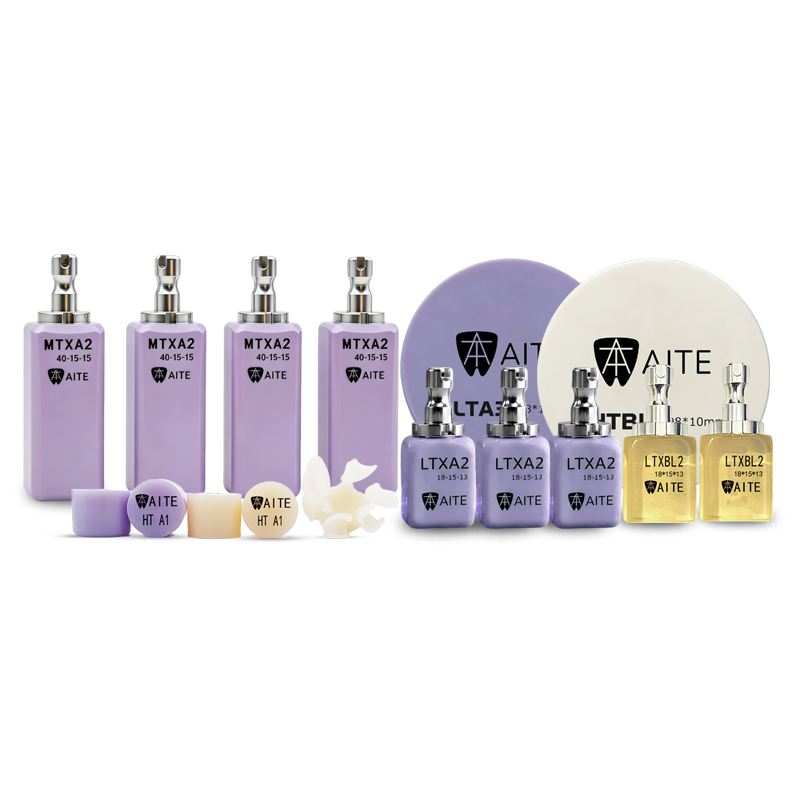
The mainstream substrate for glass ceramics is lithium disilicate. With its excellent aesthetic properties, it is the preferred core material for anterior tooth aesthetic restoration in clinical dentistry. It supports two mature processing techniques: hot die casting and CNC milling. It can be adapted to the fabrication of restorations of different shapes and difficulties. Its overall adaptability is extremely strong and it is widely recognized by clinicians and technicians.
Core advantages
1. Top-notch aesthetic performance: It has a complete range of shades from high translucency to medium translucency to low translucency. The translucency, opalescent texture and fluorescence reaction can highly replicate the physiological characteristics of natural teeth. The finished product after artificial coloring and high-temperature glazing is natural and realistic with a full sense of layering. It is the best choice for ultra-thin veneers for anterior teeth and aesthetic restoration of anterior single crowns.
2.Excellent biocompatibility: The overall chemical properties are extremely stable, and no harmful substances will be precipitated in the complex acid-base and saliva environment of the oral cavity. It is not irritating to the gums and oral mucosa. It has no foreign body sensation after wearing, does not cause redness, swelling and allergies, is safe and comfortable, and is suitable for most patients' physiques.
3.High dimensional accuracy: The material has an extremely low shrinkage rate during molding, resulting in a restoration with excellent marginal fit that can closely conform to the abutment tooth, effectively preventing food impaction and significantly reducing the probability of secondary dental caries and periodontal inflammation.
4.Flexible processing: It can be used to create complex-shaped repairs in one piece through hot die casting, or to use CNC equipment to precisely mill conventional repair parts. The matching special glaze is easy to use, has a high error tolerance, and a high finished product qualification rate, which can meet personalized and batch repair needs.
Main disadvantages: Its overall strength is weaker than zirconia, making it unsuitable for multi-unit long bridges of posterior teeth or areas with heavy occlusal forces. Long-term exposure to extremely high occlusal forces carries a risk of breakage.
Applicable scenarios: Primarily used for anterior aesthetic veneers, anterior single crown restorations, inlays, high-mounted inlays, and single-tooth implant abutment restorations. It can also meet the needs of dental institutions for batch aesthetic restorations and permanent aesthetic restorations. Clinically, it is often used for single-tooth restorations and various cases requiring extremely high aesthetics and realism, as well as standardized batch restorations.
Zirconia
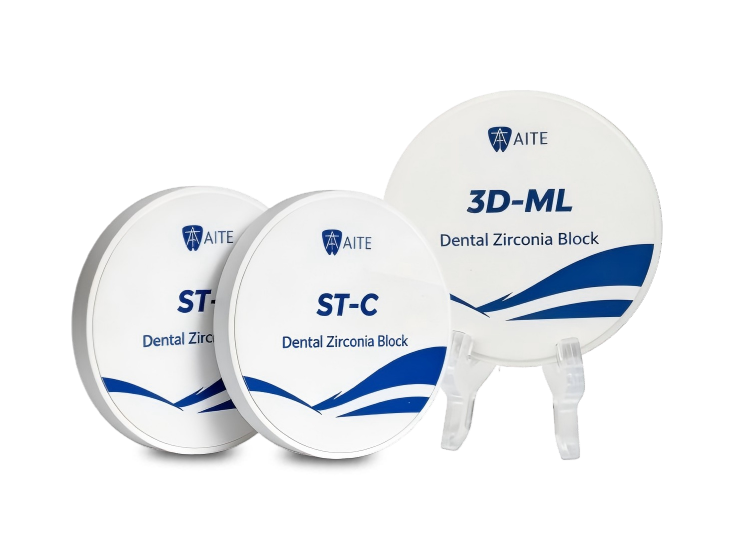
Zirconia, also known as zirconia ceramic, is hailed as the "hardcore restorative material" in the dental field due to its ultra-high mechanical strength and excellent structural toughness. It is also the most widely used and clinically applied all-ceramic restorative material. The industry mainly uses high-precision CNC cutting as the core processing method, resulting in extremely high stability of the finished product.
Key Advantages
1.Maximum Strength & Toughness: Possesses superior bending, cracking, and wear resistance, with extremely strong overall load-bearing capacity, perfectly capable of handling the enormous occlusal forces in the posterior tooth region, and suitable for complex cases of severe occlusion, bruxism, and other high-intensity occlusion.
2. Wide range of applications: It can be used to fabricate various restorations such as single crowns, multi-unit bridges, full-mouth occlusal reconstruction and restoration, implant abutments, and denture frameworks. It can simultaneously take into account the aesthetic restoration of anterior teeth and the load-bearing restoration of posterior teeth, achieving adaptation to all oral scenarios.
3. Excellent durability: The material has a dense and uniform structure and stable physical and chemical properties. It has excellent anti-aging, anti-corrosion and anti-wear capabilities. It is not easily deteriorated or damaged in the complex environment of the oral cavity. Its clinical service life is far longer than that of ordinary restorative materials, and the long-term restorative effect is stable.
4. High cost performance: The zirconia blanks on the market have complete specifications and rich categories. They can be perfectly adapted to various three-axis and five-axis CNC milling equipment. The processing process is highly standardized and is very suitable for large-scale mass production in dental processing plants. The overall production cost is controllable.
Main disadvantages:
1. If conventional zirconia full-zirconia material is used to fabricate the restoration, the overall translucency will be significantly weaker. Even with high-translucency zirconia, the translucency and opalescent effect are still inferior to glass ceramics. In ultra-thin veneer restorations for anterior teeth seeking ultimate aesthetics, the simulation effect will be slightly less impressive.
2. The material itself is hard and dense, resulting in greater wear and tear on equipment and tools during CNC machining. This will slightly increase the cost of replacing consumables and the processing time.
Applicable Scenarios: Primarily used for multi-unit fixed restorative bridges, full occlusal reconstruction and restoration, implant abutments, fixed denture frameworks, and other scenarios. It is designed for high-strength, high-load, and high-stability permanent restoration cases, making it the core material for complex posterior tooth restorations and full mouth restorations.
PMMA(Dental resin)
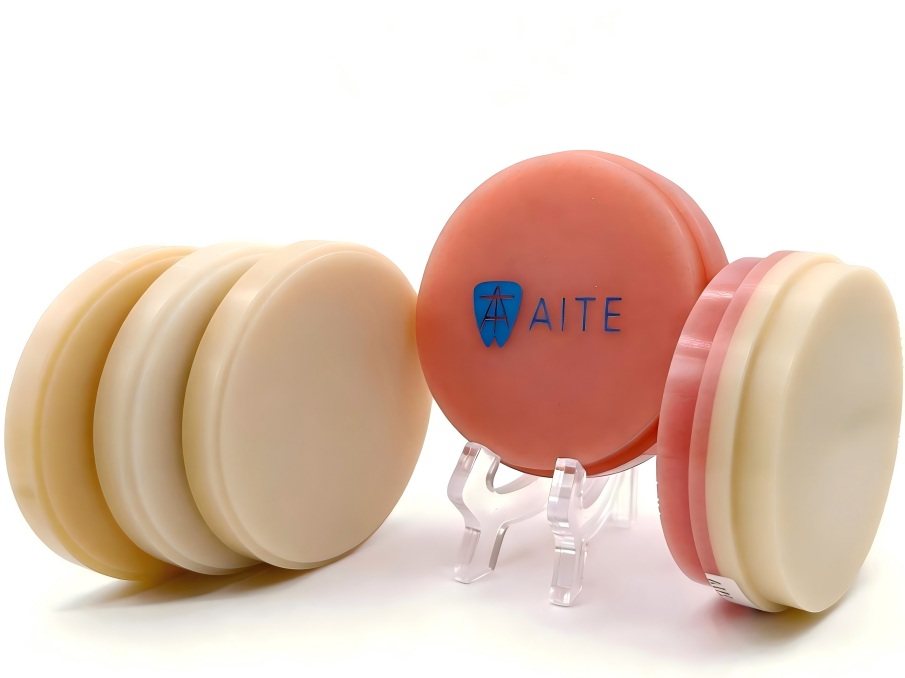
PMMA, scientifically known as methyl methacrylate resin, is a classic polymer resin material used in oral treatment. It is also a core material for clinical temporary restorations and preoperative trial model making. It has extremely low overall processing difficulty, low learning threshold, and extremely high processing efficiency, making it an essential material for oral treatment.
Key advantages:
1. Easy to process and highly efficient: The material is soft and delicate, with minimal resistance in CNC cutting. It has very low requirements for the precision of processing equipment and special tools, resulting in fast processing speed and high forming efficiency, which greatly shortens the production cycle for technicians.
2. Lightweight and comfortable: The finished product is lightweight, resulting in minimal foreign body sensation in the patient's mouth and greater comfort. It also makes subsequent clinical adjustments, occlusal adjustments, and edge grinding and shaping very convenient, and chairside operation is highly efficient.
3. Cost-friendly: The raw materials are affordable and cost-effective, with no high consumable costs, making it ideal for mass production of temporary restorations and diagnostic models, effectively helping dental institutions control operating costs.
4. High adaptability: In clinical practice, it is often used to make preoperative trial restorations, occlusal simulation guides, and temporary crowns and bridges. It can intuitively show the shape and occlusal status of the restored teeth, and effectively assist in doctor-patient communication and determine the final restoration plan.
Main disadvantages:
1. Low strength and easy wear: The overall material strength is low and its wear resistance is poor. It cannot withstand the large occlusal forces in the oral cavity for a long time and is prone to wear, deformation, and cracking. It should never be used as a permanent restorative material for posterior teeth.
2. When exposed to the oral cavity's saliva and acidic/alkaline environment for a long time, it is prone to aging, water absorption, and surface roughness. Its stability is poor, and its service life is very limited, suitable only for short-term use.
Applicable Scenarios: Widely used in clinical temporary crown and bridge restoration, preoperative diagnostic fitting, occlusal correction guide, orthodontic auxiliary accessories, and restoration simulation model making. It is only used for short-term transitional restoration and preoperative auxiliary diagnosis and treatment in oral clinics and is not suitable for permanent restoration scenarios.



 EN
EN
